Portuguese symbols in tattoos: what is behind each one
Portugal has strong symbols with real history. If you want to carry something of it on your skin, here is what each one stands for and what to know first.
Updated 6 November 2026
Barcelos rooster
The legend says a Galician on his way to Santiago de Compostela was accused of stealing silver in Barcelos and sentenced to hang. In front of the judge he pointed at a roast rooster and said it would crow if he were hanged. It did, and he was freed. There are several versions: the accused is not always a pilgrim or a Galician, and the story has no firm date. A 17th-century calvary, now in the Archaeological Museum of Barcelos, is tied to the episode. Today the rooster is linked to faith, luck and justice, and it is one of the most recognised symbols of the country.
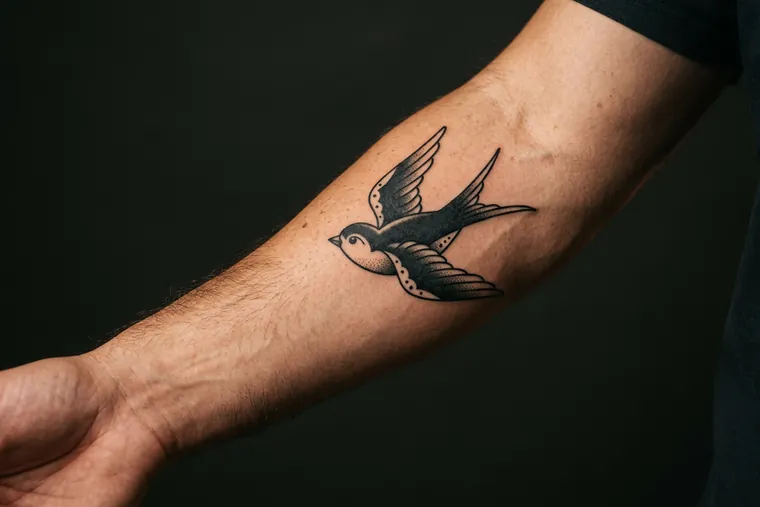
Swallow
In sailors' tradition the swallow means hope and a safe return home, because spotting one was a sign that land was near. It is said a sailor earned the first after about 5,000 nautical miles, but that is oral tradition with no confirmed origin.
Azulejo
The word comes from Arabic and means small polished stone. Glazed tiles reached the Iberian peninsula through Arab influence, and in Portugal they are recorded from the 15th century, with Seville as the model. Blue and white, under the influence of Dutch ceramics, took hold from the middle and especially the second half of the 17th century. In tattoos they work well in fine line or in ornamental patterns.
Caravel
A small, fast ship rigged with triangular lateen sails, or a mix of lateen and square. In the 15th century it was the main ship of Portuguese explorers such as Diogo Cão and Bartolomeu Dias, in the time of Prince Henry the Navigator. It stands for adventure, the sea and the Age of Discovery.
Armillary sphere and Cross of Christ
- Armillary sphere: a model of rings used in astronomy. It was the personal badge of Manuel I even before he was king, and it returned to the Portuguese arms and flag in 1911.
- Cross of Christ: the emblem of the Order of Christ, founded in 1319. Under Prince Henry it became tied to the sea voyages and appeared on the sails of caravels and carracks.
What to think about first
Talk to us about size: a lot of detail on a small piece gets lost. For religious symbols, see Our Lady of Fátima and pilgrim tattoos. For patterns like azulejo, read ornamental tattoos.
Price at SORRY MOM
The consultation is free and takes about 20 minutes, and the price is fixed before we start. Tattoos start at 60 €, a session by area is 250 €, and large projects run over several sessions with the price given at the consultation. You can pay in 3 interest-free instalments with Klarna. We are at Av. Beato Nuno 423, Fátima, Monday to Saturday, by appointment only.
Questions
Does the Barcelos rooster have one single meaning?
No. The legend is about innocence proved by a miracle, but today many people see faith, luck, tradition and Portuguese identity in it. The meaning is what you give it.
Can an azulejo be tattooed small?
It can, but very small patterns blur over time. At the consultation we adjust the size so the design stays readable.
Are these symbols only for Portuguese people?
No. Many visitors take a Portuguese symbol home as a memory. It just helps to know the meaning so you choose it knowingly.
 Flower tattoos: what each flower usually means